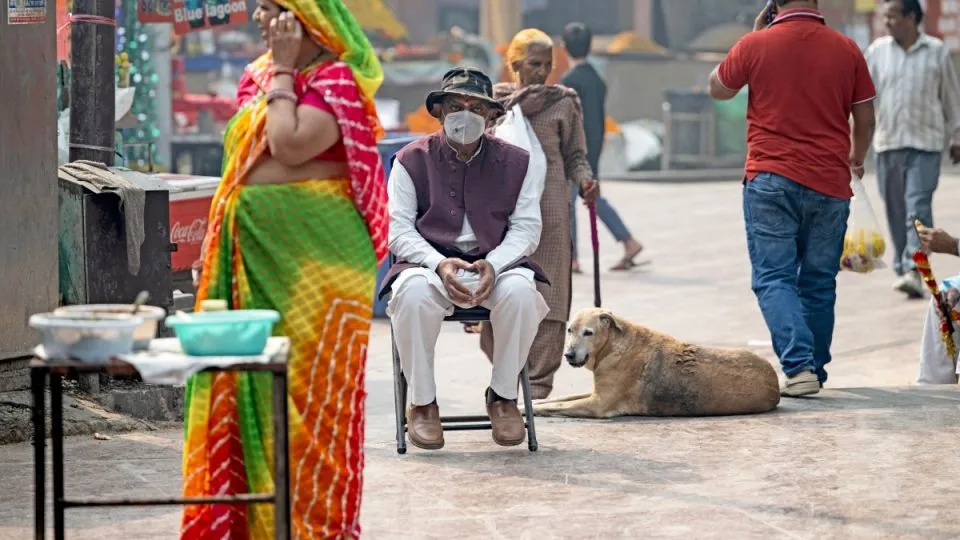
Arya News - Blanketed by a thick gray haze as readings breached 400 across multiple monitoring stations, the national capital woke up gasping following Diwali festivities.
NEW DELHI – Delhi woke up to another morning of hazardous air on Monday, with the Air Quality Index (AQI) crossing 400 in parts of the national capital after Diwali, even as the worsening pollution triggered a political confrontation between the ruling Bharatiya Janata Party (BJP) and the opposition Aam Aadmi Party (AAP).
The Central Pollution Control Board (CPCB) recorded an AQI of 406 at ITO around 4.20 am, placing the area in the ‘severe’ category. Rajiv Chowk registered 381 at 1.30 am, while South Extension recorded 360 at 4 am, both in the ‘very poor’ category.
A thick layer of smog reduced early-morning visibility across several areas, including Inderlok. The pollution episode followed Diwali celebrations on Sunday, with Stage III restrictions under the Graded Response Action Plan (GRAP) already in force across Delhi and the National Capital Region (NCR).
Why Delhi’s AQI readings are a concern
Under the CPCB’s classification, an AQI between 301 and 400 is considered ‘very poor’, while readings from 401 to 500 fall in the ‘severe’ category.
Severe air quality can affect healthy people and seriously impact those with existing respiratory or cardiac conditions. Even the ‘very poor’ category carries the risk of respiratory illness following prolonged exposure.
The ITO reading of 406 was a local monitoring-station figure, rather than Delhi’s citywide average. Readings at Rajiv Chowk and South Extension remained below the severe threshold but indicated widespread pollution across the capital.
The Commission for Air Quality Management (CAQM) had invoked GRAP Stage III on November 6, when Delhi’s daily average AQI stood at 382, reflecting deteriorating conditions even before Diwali.
What GRAP Stage III restrictions mean for Delhi
The restrictions cover several dust-generating construction and demolition activities, alongside curbs on older petrol and diesel vehicles in Delhi and designated NCR districts.
BS-III petrol and BS-IV diesel four-wheelers face restrictions, subject to applicable exemptions. The measures also require hybrid classes for students up to Class V wherever online learning is feasible.
Governments may additionally decide on reduced office attendance and work-from-home arrangements under the prescribed framework.
Stage III remains active as authorities attempt to contain pollution levels following the festive period.
Kapil Mishra accuses AAP of targeting Diwali
Amid the pollution crisis, Delhi Minister Kapil Mishra accused AAP national convenor and former chief minister Arvind Kejriwal of preparing a campaign against Diwali and Sanatan Dharma under the pretext of raising concerns over air pollution.
In a post on X, Mishra alleged that AAP leaders and paid celebrities would be mobilised to target the festival.
The BJP leader also blamed the previous AAP administrations for pollution in Delhi and Punjab, alleging that years of corruption had contributed to the crisis.
AAP questions Centre’s pollution response
AAP leader and former Delhi minister Saurabh Bharadwaj, meanwhile, accused the BJP-led Central government of failing to address air pollution across northern India over the past decade.
In a series of posts on X, Bharadwaj argued that the problem extended beyond Delhi to Uttar Pradesh, Bihar, Haryana, Rajasthan and Punjab, requiring intervention at the national level.
He questioned why the Centre had previously blamed Delhi and was now attributing pollution to Punjab.
Bharadwaj also criticised violations of firecracker restrictions, sharing purported pollution readings of 999 and above 3,000.
Former Delhi mayor Shelly Oberoi also criticised the BJP government, demanding measures to tackle the pollution and warning of the health risks faced by children and elderly residents.
In a post on X, Oberoi called for concrete action rather than political rhetoric.