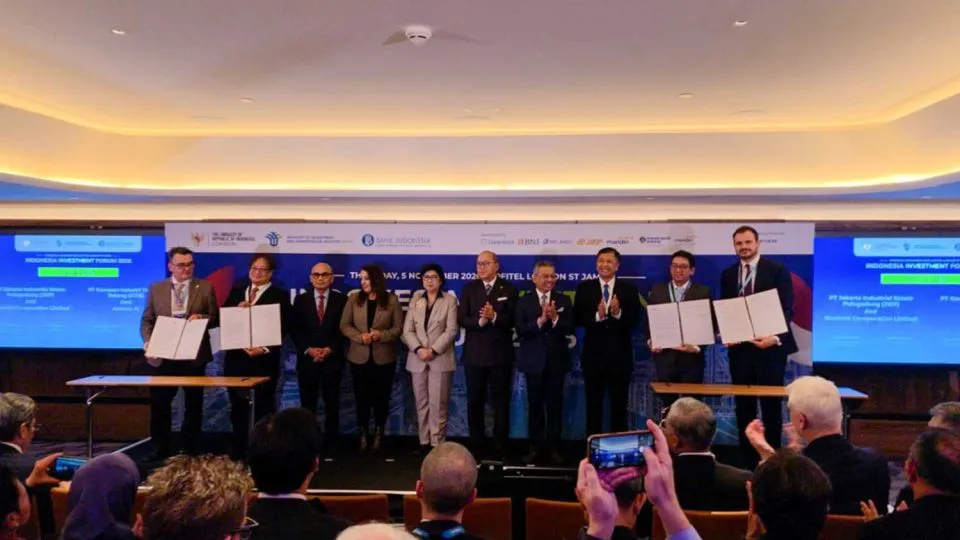
Arya News - Finance Minister Suahasil Nazara emphasised the need to grow investment by 7 per cent to help reach the country’s gross domestic product target.
JAKARTA – The government has unveiled investment agreements worth a combined US$385 million in technology and downstream industries during a trip to London, as part of efforts to boost investment and achieve economic growth targets.
The delegation included Finance Minister Suahasil Nazara, Bank Indonesia (BI) Governor Destry Damayanti, as well as Investment and Downstream Minister Rosan Roeslani, who attended the Indonesia Investment Forum 2026 in the United Kingdom on Thursday to promote investment opportunities in the country.
At the forum, Indonesia secured new partnership agreements in artificial intelligence (AI), industrial estate development and tin downstreaming, aimed at providing “new technology and increasing added value in the country”.
The agreements include a partnership between Central Java-based industrial estate operator PT Kawasan Industri Terpadu Batang (KITB) and European chip company Axelera AI to explore AI ecosystem development, with an investment value of $56 million.
PT Jakarta Industrial Estate Pulogadung also partnered with asset management and investment services firm BlackInk Co-operation Ltd in a $77 million investment agreement, which focused on the utilization of the industrial land.
Additionally, the government announced a Letter of Intent from private investment firm Titanium Capital for a project worth $252.1 million in the tin downstream industry.
Speaking at the forum, Minister Suahasil emphasized the need to grow investment by 7 percent to help reach the country’s gross domestic product target.
“To reach the target of 6 percent economic growth in 2027, investment must grow by around 7 percent. Therefore, the government continues to promote a favorable investment climate with the support of the state budget, [state asset fund] Danantara and partnerships with the private sector,” he stated.
He expressed hope that these investment agreements could increase production capacity, strengthen domestic industry, as well as create new jobs and expand economic opportunities to drive further growth.
Indonesia’s GDP expanded by 5.47 percent year-on-year (yoy) in the third quarter, up from the second-quarter reading of 5.29 percent, according to data from Statistics Indonesia (BPS) published on Thursday.
The third quarter reading brings the economic growth rate to 5.45 percent in the first nine months.
The national economy improved on the back of a growing trade balance, while consumer spending and business investment slowed from the preceding three months.
Accounting for 30.81 percent of the GDP pie, gross fixed capital formation (GFCF), which reflects investment in fixed assets like buildings, machinery and equipment, grew by a robust 6.06 percent yoy, easing slightly from 6.87 percent in the preceding quarter.
It was in line with softer domestic direct investment (DDI) during the third quarter. Contrasting last year’s trend, foreign direct investment (FDI) dominated direct investment in Indonesia so far this year as domestic investment waned.
Rosan, who also serves as Danantara chief executive officer, revealed in October that realized direct investment in the third quarter reached Rp 528.7 trillion ($29.4 billion), up 7.6 percent from the same period of last year.