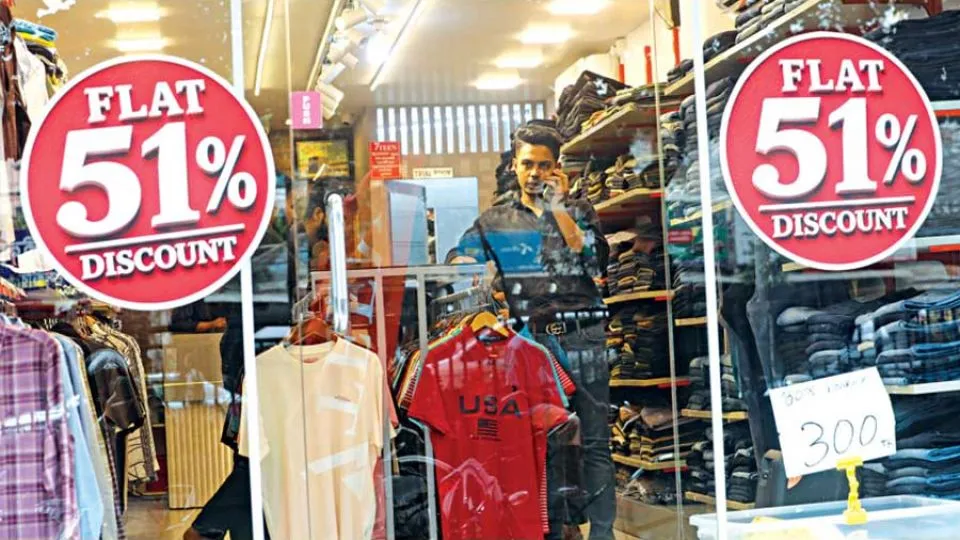
Arya News - Up to 50% off is not enough to draw shoppers back as the rising cost of living, shorter shopping hours and odd weather keep customers away.
DHAKA – Shoppers are shying away from clothing stores even though retailers are offering discounts of up to 50 percent, as years of near-double-digit annual inflation have stretched people to their limit.
Besides, it is an unfavourable season for retailers. Puja spending ended only weeks ago, and the weather suits neither summer nor winter clothes.
Shops also have fewer hours to catch customers. To save energy during a nationwide crunch, markets, malls and shops can now remain open from 11 am to 8 pm, down from at least 10 pm previously. That cuts into the evening, when people usually shop after work.
Retailers say their sales have fallen by at least 20 percent compared with the same period last year.
“You now see these shelves stacked with dresses, but those were almost empty at this time last year after we began the discount sales,” said Md Safin, manager of Saima Fashion Outlet in Banani.
The brand sells womenswear such as shalwar kameez, saris and lehengas, and has several outlets across the city.
“I could not even manage the time to talk to you this time last year,” Safin said with a shrug, “But the business condition this time is different. Customers are few and far between.”
“Our sales have dropped by 30 percent compared to the same period last year,” he estimated.
According to Safin, people feel uncertain amid local political protests, a war-driven global energy shock and the abrupt rises in fuel and power prices that followed. These have clouded the business environment as well as damaged consumer confidence, he said.
He added that the shorter shopping hours have also hurt sales.
Soumik Das, chief executive of Rang Bangladesh, one of the leading local fashion and lifestyle brands, said people are not buying as much as they did last year because high inflation has dragged on.
The current wave of brutal inflation began in mid-2022. Since the fiscal year 2022-23, average annual inflation has stayed above 9 percent, while wage growth has remained below it.
For the current fiscal year 2026-27, the International Monetary Fund (IMF) has projected average inflation of 10.9 percent and lower real GDP growth of 3.2 percent. Combined with inflation, that means fewer new jobs, costlier essentials and lower earnings.
“Our discount offers have failed to draw the response seen last year,” said Soumik. “Customer footfall has dropped by at least 15 percent to 20 percent this time compared to last year.”
“Even those who are buying at a discount are doing so only for specific needs. They are not buying beyond what they need. Earlier, during offers, many would buy more than they required,” he said.
Apart from economic conditions, the weather has added to the confusion. Cooler temperatures in early November usually herald the arrival of winter, but this year they have been unpredictable, leaving shops unsure what to put on display.
Mbrella, a popular menswear brand, put winter hoodies on its shelves in early November, but the mercury jumped days later, and it had to take them off.
The brand said demand for summer items such as comfortable T-shirts and polo shirts is not strong now despite discounts, yet it is not the right time to start selling winter clothes either.
“Our sales have fallen short of expectations,” said Kazi Maktum Shovon, head of sales and marketing at Mbrella.
He cites the 8 pm shop closing rule as one factor. “Durga Puja ended just a few days ago, and Eid is coming up. That is also why we are not getting the response we expected,” he said.
Maktum expected sales in the coming months to stay somewhat below projections.
Similarly, Mohammad Muktar Hossain, assistant manager of fashion brand Rise, said pre-winter discounts this year have not drawn the sales seen last year.
“Last October, when we ran discount offers, we sold products worth around Tk 20 lakh. This year, that has dropped to Tk 15 lakh,” he said.
He blamed the economic situation, especially a sharp rise in the cost of living. “Customer footfall this season has halved, and only a few of them are making purchases.”
Sazzad Hossain, online sales executive at Cats Eye, another popular lifestyle and fashion brand, said sales have dropped by around 50 percent compared with last year.
“Customers are in a wait-and-watch mode, wondering what will happen in the coming days, since the overall economic situation is not stable. So, they are holding back,” he said.
At New Market, non-brand clothing shops had yet to bring in new winter stock last week. Some were trying to clear their old stock with discounts.
Sanaul Haque Babul, director of finance at the Fashion Entrepreneurs Association of Bangladesh, a trade organisation representing local fashion brands, told The Daily Star that retailers traditionally offer discounts at this time of year to boost sales, with the off-season under way.
This year, however, sales have fallen by 20 percent compared with the same period last year, as the country’s political and economic situation continues to weigh on demand, he added.