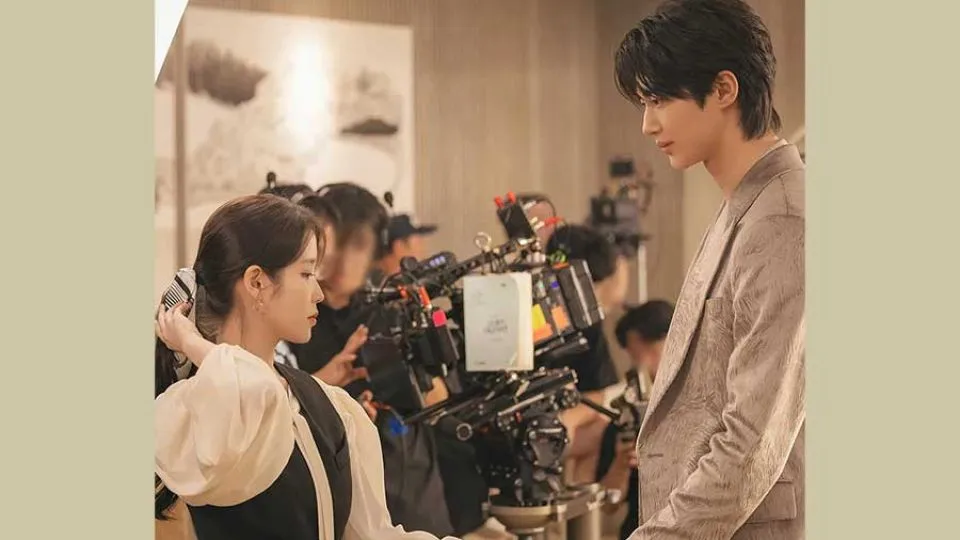
Arya News - A fragmented production system and reliance on shooting live leave crews facing grueling hours, safety risks, insecure contracts, and inadequate pay.
SEOUL – A fragmented production system and reliance on shooting live leave crews facing grueling hours, safety risks, insecure contracts and inadequate pay
South Korean television, driven by its idiosyncratic, nuanced portrayals of human relationships and bold storytelling, is dominating international charts. But beneath the industry’s high-production gloss lies a less flattering reality: working conditions that fail to keep pace with its growing global stature.
Despite its standing as a major force in the global entertainment industry, Korea’s drama sector continues to grapple with precarious employment arrangements, unfair contracts and excessive working hours — problems rooted in a fragmented production system that has yet to establish adequate labor protections.
According to findings released Oct. 24 by the Hanbit Media Labor Rights Center, based on a two-month study of 237 crew members, Korean television industry personnel worked an average of 54 hours and 23 minutes per week, exceeding the legal maximum of 52 hours.
Night shifts were similarly prevalent, with departures between 10 p.m. and 6 a.m. representing 24.8 percent of all logged shifts. Furthermore, workers had less than 11 hours of rest before returning to set in 31 percent of recorded cases.
The problem comes as Korea’s drama industry continues to rely on a fragmented production structure.
While the US television industry operates under more standardized employment structures, the Korean drama sector is characterized by a decentralized supply chain involving producers and outsourced vendors.
Under this model, crew members are typically contracted on a project-by-project basis, often under flexible project agreements rather than fixed employment contracts.
With operational duties divided across multiple production layers, establishing uniform standards for scheduling, compensation and rest periods remains an ongoing industry challenge.
Labor conditions face added pressure due to the Korean drama sector’s widespread practice of real-time production rather than adopting the full preproduction framework standard in the US.
“Concurrently producing and airing content leads to compressed delivery timelines, ultimately worsening already difficult working conditions,” said Lee Moon-haeng, a professor of media communications at Suwon University.
Experts say the gap between Korea’s drama industry and other cultural sectors — particularly film — is especially stark.
“In the film industry, productions seeking investment from the state-backed Film Development Fund are required to use standard contracts, given that public funds are involved,” said Lee Sung-min, an associate professor in the Department of Media Arts and Sciences at Korea National Open University.
“Major investors and distributors have also helped institutionalize standard employment contracts through mutual cooperation agreements, making their use relatively established in film production,” he said.
“The drama industry, however, has far fewer such mechanisms, with the extensive outsourcing and multiple funding sources involved in each production,” he added.
Progress, but with gaps
Despite the ongoing challenges, experts share the view that working conditions have gradually improved over the past decade, particularly following the introduction of Korea’s 52-hour workweek system.
Introduced in phases beginning July 1, 2018, the system was extended to workplaces with five or more employees by July 1, 2021, setting a basic 40-hour workweek with up to 12 additional hours of overtime.
“My impression is that … the introduction of the 52-hour framework has helped establish clearer expectations around working time,” said Thomas Suh, a Seoul-based producer and screenwriter.
He said the industry has made progress in addressing working-hour issues over the past decade, particularly in recognizing that working hours are production responsibilities that should be factored in.
But significant disparities remain in other areas, especially in workplace safety and workers’ compensation.
Lee Sung-min said that while compliance with working-hour regulations has improved, inadequate use of standard employment contracts continues to leave many broadcast workers without adequate protection against workplace accidents and injuries.
“Enrollment rates in employment insurance and industrial accident compensation insurance among Korean television personnel remain very low,” he said.
“Without standard employment contracts, many workers are excluded from industrial accident compensation insurance, leaving gaps in workplace safety protections,” he said.
New media, new labor challenges
The challenges are becoming more complicated as drama production expands beyond traditional television broadcasters.
The rise of global streaming platforms including YouTube, as well as web series and short-form vertical dramas, has fragmented the market into smaller production entities and independent creators. Consequently, crew and performers are routinely hired under freelance service agreements rather than employment contracts.
This vulnerability is especially severe in short-form and YouTube projects, where verbal agreements, short-term shooting schedules and nonnegotiable lump-sum pay are common.
Unlike broadcast productions, YouTube content is not legally classified as broadcasting and therefore falls outside the reach of many existing measures, including labor-condition monitoring and standard contract requirements.
Addressing these disparities requires modernized regulatory oversight and a broader labor safety net suited to the realities of nontraditional media work.
“We need clear distinctions between independent creative work and employment under someone else’s direction,” Suh said.
“Priorities should include accurate employment classification, clear contracts, proper records of working hours and practical ways to challenge violations. Smaller production businesses also need guidance on their responsibilities as employers,” he added.
However, developing such protections for the new media sector remains a challenge, as government bodies have yet to establish clear roles and coordinated systems.
“Policy discussions surrounding the new media sector are ongoing, but conflicting interests and approaches across policy areas have made implementation difficult,” Lee Sung-min said.
“Bodies such as the Korea Creative Content Agency and the Ministry of Culture, Sports and Tourism have yet to take an active role, while the Korea Communications Commission has limited policy tools to address individual workers’ labor issues,” he said, pointing to the need for clearer divisions of responsibility among government agencies to better protect workers in the new media sector.