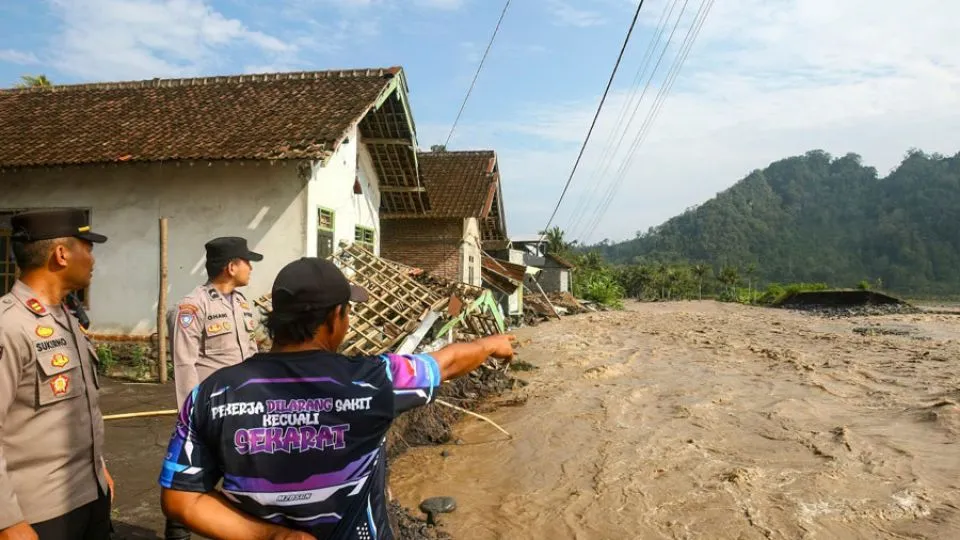
Arya News - The National Disaster Mitigation Agency (BNPB) on Tuesday urged residents nationwide to prepare for hydrometeorological disasters, including flash floods and landslides, as parts of the country enter the rainy season.
JAKARTA – After months of battling forest and peatland fires, parts of Indonesia now face another threat as damaged landscapes leave communities increasingly vulnerable to flooding ahead of the rainy season.
The National Disaster Mitigation Agency (BNPB) on Tuesday urged residents nationwide to prepare for hydrometeorological disasters, including flash floods and landslides, as parts of the country enter the rainy season.
The warning comes after months of drought and widespread forest and peatland fires, fueled by prolonged dry conditions under the influence of El Niño, which have left communities grappling with water shortages and toxic haze.
The Meteorology, Climatology and Geophysics Agency (BMKG) has forecast that the rainy season will begin in most parts of Indonesia between November and December, although the brewing El Niño could delay its peak into next year.
Intermittent rainfall in recent days has helped suppress fires in major hot spots across Kalimantan and Sumatra, gradually dispersing toxic haze and bringing air quality closer to safe levels. But the reprieve could come with a new threat.
“We also need to anticipate an increased risk of flooding, particularly in areas where blazes have destroyed tree covers and degraded the soil,” BNPB spokesperson Berton Panjaitan said.
In several peatland-rich regions, including South Sumatra, Central Kalimantan, South Papua and Riau, local disaster agencies have flagged heightened flood risks as rainfall intensifies.
The Riau provincial administration has allocated Rp 2.1 billion (US$115,688) to repair the Sontang-Duri highway, a critical logistics route recently inundated by floodwaters from the overflowing Rokan River in Bengkalis regency.
Monoculture aftermath
At least 1.92 million hectares of land, an area larger than Timor-Leste, burned in the first nine months of this year, according to independent forest monitoring group Nusantara Atlas.
The fires have further exposed the vulnerability of peatlands drained for monoculture plantations, which have been widely implicated in recurring blazes across Kalimantan, Sumatra and Papua.
A 2025 report by peatland-focused NGO Pantau Gambut identified a “high-risk” of flooding in roughly a quarter of Indonesia’s 24 million ha of peatland hydrological units (KHG).
Peatlands naturally function as reservoirs for water and carbon. But when drained and dried out, their soil can become hydrophobic, meaning it repels water rather than absorbing it.
“Consequently, [degraded] peatlands lose their ecological capacity to store water, causing a quick water run-off and elevating the risk of waterlogging and flooding in surrounding areas,” Pantau Gambut senior campaigner Putra Saptian told The Jakarta Post, Tuesday.
The report identified Central Kalimantan, West Kalimantan, South Sumatra and Riau as the four provinces facing the highest flood risks. All four were also among the six provinces prioritized by the government for firefighting operations.
Climate and disaster expert Edvin Aldrian, who serves on the United Nations Intergovernmental Panel on Climate Change (IPCC), said the looming flood threat should also be viewed against decades of unchecked expansion of monoculture plantations across Kalimantan and Sumatra.
Indonesia has been the world’s largest palm oil producer since 2007, with extensive oil palm concessions occupying drained peatlands in Kalimantan, Sumatra, and more recently, South Papua.
“Oil palm roots cannot store or retain water as effectively as a natural peatland or forest,” Edvin said.
He said restoring damaged ecosystems was therefore essential, particularly given the recurring involvement of oil palm plantations in forest and peatland fires.
Putra of Pantau Gambut also called for corporations complicit in the destruction of peatland ecosystems be held accountable, including through mandatory landscape restoration.
During this year’s fire season, which sent toxic haze drifting into neighboring countries, President Prabowo Subianto revived the national peatland agency, raising hopes of stronger efforts to restore degraded ecosystems.
However, skepticism remains over whether the National Peatland and Mangrove Management Agency (BPGMN), which replaces the former Peatland and Mangrove Restoration Agency (BRGM), will have the authority and resources to curb unchecked land conversion and hold plantation companies accountable for further peatland destruction.